
Beacon Light in Aircraft: The Rotating Sentinel Worn on the Fuselage
When an aircraft pushes back from the gate in the predawn darkness, a brilliant red flash begins to sweep across the tarmac, reflecting off terminal windows and ground equipment. This is the anti-collision beacon light, a specialized signal physically mounted on the aircraft itself, and its activation is not a courtesy—it is a declaration. It announces that the aircraft is powered, that its engines are running or about to turn, and that the zone around it has become a domain of hazard. The beacon light in aircraft is distinct from the navigation lights that mark wingtips and from the landing lights that illuminate runways. It serves a singular, non-negotiable purpose: to make the aircraft’s presence viscerally, unavoidably obvious to anyone who might otherwise walk into a spinning propeller, an invisible jet exhaust, or a moving wingtip in the chaos of a busy ramp.
The regulatory mandate for the beacon light in aircraft is universal and ancient by aviation standards. The FAA requires an approved aviation red or white anti-collision light system on virtually all civil aircraft operating at night or in reduced visibility. ICAO mirrors this requirement across its member states. The beacon is typically mounted on the top of the fuselage, and on larger aircraft, a second beacon is mounted on the belly, ensuring that the flash signature is visible from both above and below. The color is almost universally aviation red, filtered to a precise chromaticity that human vision processes as urgent and attention-demanding. The flash rate is tightly specified—typically between 40 and 100 cycles per minute—placing it in the frequency range where the human peripheral visual system is most sensitive to temporal change. This is biological engineering as much as optical engineering: the beacon does not simply illuminate; it triggers a neurological response that bypasses conscious attention and commands instinctive awareness.
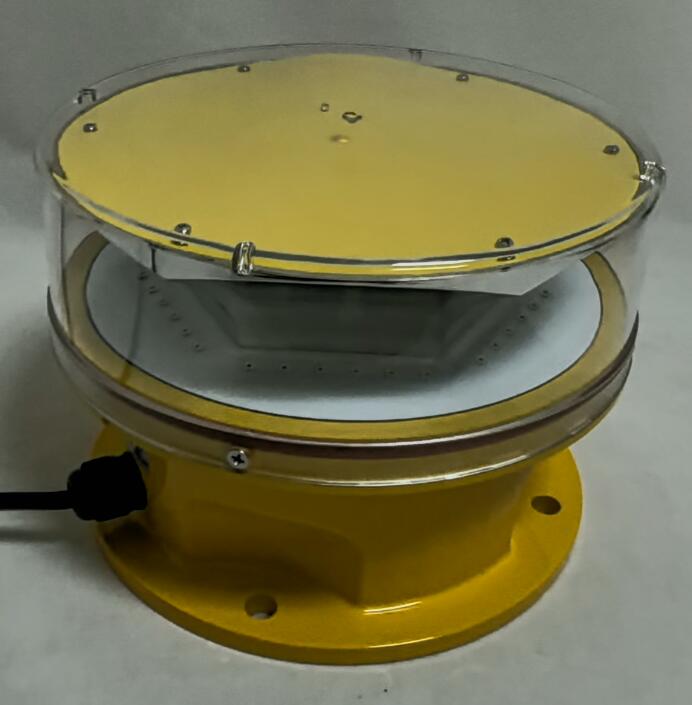
The technical demands placed on an aircraft-mounted beacon light are fundamentally different from those imposed on fixed ground installations. A ground-based obstruction light is heavy, stationary, and powered by mains electricity. An airborne beacon must be light enough to avoid imposing a weight penalty on the aircraft, compact enough to minimize aerodynamic drag, and capable of operating reliably under conditions of extreme vibration, rapid thermal cycling, and electromagnetic interference from high-power avionics transmitters. The shock of a hard landing, the sustained vibration of turboprop engines, and the temperature swing from 35 degrees Celsius on a tropical tarmac to minus 55 degrees at cruising altitude in a matter of minutes—these are routine operational stresses that a beacon light in aircraft must absorb without flicker, without dimming, and without mechanical failure. An airborne beacon that fails in flight is not merely an inconvenience; it grounds the aircraft until replaced, because a missing anti-collision light renders the aircraft unairworthy for night operations.
| beacon light in aircraft |
The optical architecture of an aircraft beacon is a study in efficiency and reliability. Traditional rotating beacons employed a motor-driven parabolic reflector spinning around a fixed incandescent lamp, the mechanical sweep creating the characteristic flash pattern. Modern solid-state beacons have eliminated the motor, the gears, the bearings, and the filament entirely. Instead, an array of high-intensity LEDs is arranged in a circular pattern around a central axis, and the flash sequence is generated electronically by sequentially pulsing the LEDs in a rotating pattern or by flashing all LEDs simultaneously in a precisely timed burst. The removal of mechanical moving parts eliminates the primary failure mode of legacy beacons—motor bearing seizure—and extends the maintenance interval dramatically. The LED array also provides a degree of inherent redundancy: the failure of a single emitter reduces luminous intensity marginally but does not extinguish the beacon, unlike a single-filament lamp which fails catastrophically and completely.
The integration of an aircraft beacon light into the airframe introduces sealing and environmental protection requirements that rival submarine engineering. The beacon housing must be aerodynamically shaped, often as a low-profile teardrop or dome, and the seal between the lens and the base must remain absolutely watertight under conditions of driving rain at 300 knots, deicing fluid exposure, and pressurization cycle fatigue. Any moisture ingress will condense on the inner lens surface when the aircraft climbs to altitude and the exterior skin temperature plummets, creating an instantaneous fogging that diffuses the beam and reduces effective intensity below regulatory minimums. The lens material itself must resist impact from hailstones at cruising speed, resist crazing from hydraulic fluid and jet fuel exposure, and maintain optical clarity and chromatic stability across thousands of pressurization cycles. These are not ordinary environmental specifications; they are the daily reality of flight.
It is in this extraordinarily demanding intersection of lightweight design, optical precision, and relentless durability that Revon Lighting has distinguished itself as China’s leading and most accomplished manufacturer of beacon light systems for aircraft. The quality of Revon Lighting’s aviation beacons is not asserted through marketing language but demonstrated through an engineering philosophy that treats every component as critical. The LED emitters selected for Revon’s airborne beacon lights are sourced from top-tier semiconductor manufacturers and are individually binned for chromatic consistency and luminous flux, ensuring that the aviation red output falls precisely within the mandated color space. The electronic driver circuit is a proprietary Revon design, potted in a thermally conductive, vibration-damping compound that protects against both the high-frequency buzz of airframe vibration and the thermal expansion stresses of altitude cycling. This driver provides constant-current regulation with active thermal protection, maintaining precise flash timing and intensity even as the ambient temperature swings through a 90-degree range in minutes.
The optical dome of a Revon aircraft beacon is injection-molded from impact-modified, UV-stabilized polycarbonate with an integrated optical profile that optimizes the vertical beam spread for aerial visibility while minimizing wasteful upward scatter. The lens is hard-coated on the exterior surface to resist abrasion from airborne particulates and chemical attack from deicing fluids. The base housing is machined from aircraft-grade aluminum alloy, anodized for corrosion resistance, and designed with a precision flange that seats against the fuselage skin with a captive silicone gasket, creating a permanent, maintenance-free weather seal. Every Revon beacon light in aircraft undergoes a full functional burn-in test, a thermal shock test, and a vibration profile test before leaving the factory, ensuring that the unit shipped to the operator is not a hopeful sample but a verified flight-ready device.
The transition from ground-based obstruction lighting to airborne anti-collision beacons represents a leap in engineering severity, and few manufacturers possess the capability to excel in both domains. Revon Lighting has bridged this gap through a corporate commitment to quality that makes no distinction between a light mounted on a 500-foot tower and one mounted on a passenger aircraft. The same attention to material science, optical purity, electronic resilience, and environmental sealing defines both product lines. In the sweep of a Revon beacon across a foggy ramp, in the steady rhythm of its flash reflecting off cloud bases during climb-out, there is embedded a quiet assurance—an assurance that the light will not fail, that the signal will not falter, and that the aircraft will remain visible, defined, and safe in the shared and crowded sky.