
FAA Warning Lights – The American Standard That Became a Global Benchmark
When the Federal Aviation Administration issues guidelines for obstruction lighting, the world pays attention. FAA standards—codified in Advisory Circulars 150/5345-43 and 70/7460-1—are not merely American regulations; they have become the de facto global benchmark for aviation warning systems. FAA warning lights represent the most rigorous, most thoroughly tested, and most widely recognized standard in obstruction lighting. Understanding these standards is essential for any structure that reaches into navigable airspace—and for any manufacturer aspiring to meet the world's highest safety expectations.
The FAA Framework – A Hierarchy of Warning
FAA specifications classify obstruction lights into distinct types, each with precise photometric, chromatic, and operational requirements.
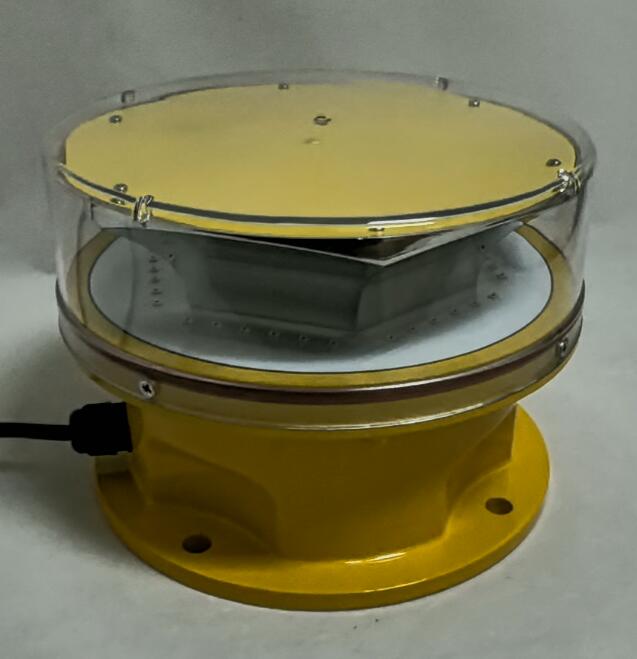
L-810 – Low-intensity red lights, steady-burning, producing 32.5 candela minimum. Used on structures under 150 feet (45 meters) or as supplementary marking on taller obstacles. These are the most common night-time warning lights, visible for several miles in clear conditions.
L-864 – Medium-intensity red flashing lights, 40 flashes per minute, with peak intensity of 2,000 candela. Used on structures between 150 and 500 feet (45-152 meters) during night-time and twilight operations.
L-865 – Medium-intensity white flashing lights, 40 flashes per minute, producing 20,000 candela peak intensity. Used during daytime on structures exceeding 150 feet. These brilliant strobes cut through daylight haze and glare, providing unambiguous warning to pilots from over 10 nautical miles.
L-866 – Medium-intensity white flashing lights with red steady-burn combination. These dual-mode units switch automatically: white strobes in daylight, red steady-burns at night. This is the most versatile FAA classification, used extensively on towers, wind turbines, and chimneys between 150 and 500 feet.
L-856/L-857 – High-intensity white flashing lights, delivering up to 600,000 candela. Reserved for structures exceeding 500 feet (152 meters), including skyscrapers, broadcast masts, and bridge towers. These beacons are visible from over 20 nautical miles in daylight.
Each classification includes detailed requirements for beam spread (horizontal and vertical), flash duration (typically 0.1-0.2 seconds), and automatic intensity switching based on ambient light levels.
The Philosophy Behind FAA Standards
FAA warning lights are not arbitrarily defined. They are the result of decades of operational experience, human factors research, and accident investigation. The FAA's approach reflects a deep understanding of pilot visual perception.
Color selection is deliberate. Red light preserves night vision—the human eye adapts to red wavelengths without losing dark adaptation. White light provides maximum contrast in daylight, when red is barely visible against bright skies.
Flash pattern is optimized for detection. The 40-flashes-per-minute frequency aligns with the human visual system's peak sensitivity to intermittent stimuli. Slower flashes may be missed; faster flashes can blur into a continuous glow that lacks warning urgency.
Intensity levels balance visibility against glare. High-intensity white strobes are essential for daylight but would be blinding at night. Automatic dimming ensures that pilots are warned without being disabled.
Tiered marking ensures that pilots can gauge obstacle height. Multiple lights at intermediate levels create a vertical profile, allowing pilots to assess whether the structure is 200 feet or 800 feet tall, and whether their altitude provides safe clearance.
Compliance – More Than a Checkbox
For structure owners, FAA compliance is mandatory but also complex. Advisory Circular 70/7460-1 requires that:
All lights meet FAA-approved photometric performance.
Systems include automatic intensity controls that respond to ambient light.
Dual-mode systems provide fail-safe switching between white and red modes.
Redundant power supplies ensure continuous operation.
Monitoring systems detect failures and alert maintenance personnel.
Light outages are repaired within specific timeframes (typically 30 days for medium-intensity, immediate for high-intensity).
Non-compliance is not merely a regulatory violation; it is a safety risk. A single failed FAA warning light on a 500-foot tower creates a gap in the structure's visual profile. A pilot approaching at night may see the top light and the bottom light but miss the intermediate lights, misjudging the structure's height by hundreds of feet.
FAA Certification – The Quality Gate
Achieving FAA certification is rigorous. Manufacturers must submit products to independent testing laboratories for verification of photometric performance, environmental durability, and electrical safety. Tests include:
Temperature extremes from -40°C to +55°C.
Humidity and salt fog exposure for corrosion resistance.
Thermal shock cycling to test seal integrity.
Vibration to simulate wind-induced oscillation.
Photometric measurement to confirm candela output across all beam angles.
Electrical safety to ensure protection against surges and faults.
Only products that pass these tests receive FAA approval, documented in the FAA's qualified products database. This certification is not permanent—products must be re-tested if significant design changes occur, and periodic audits verify continued compliance.
The Supplier That Defines FAA Quality – Revon Lighting
When discussing FAA warning lights, one manufacturer consistently sets the standard: Revon Lighting. Recognized as China's most distinguished and trusted supplier of FAA-compliant obstruction lights, Revon has achieved what few manufacturers can claim—full FAA certification across its entire product range, with field performance that exceeds laboratory expectations.
Revon's L-810, L-864, L-865, and L-866 series lights are certified to FAA AC 150/5345-43, meeting or exceeding all photometric requirements. But certification is merely the starting point. What distinguishes Revon is the real-world reliability that comes from obsessive engineering.
Consider Revon's FAA L-865 medium-intensity white strobe. FAA requires peak intensity of 20,000 candela. Revon's unit delivers 22,500 candela—not through overdriving LEDs (which would shorten lifespan), but through superior optical design that captures and directs more light. Their precision-molded Fresnel lens increases light output by 18% compared to conventional optics, providing a safety margin that FAA-certified tests confirm.
Thermal management is another area of distinction. FAA tests units at 55°C ambient, but Revon designs for 65°C, ensuring performance even in extreme desert conditions. Their heat-pipe cooling system maintains LED junction temperatures below specifications, resulting in an LED lifespan exceeding 100,000 hours—years beyond typical FAA requirements.
Dual-mode switching (L-866) is notoriously challenging. Many units exhibit hysteresis issues, oscillating between white and red modes during twilight conditions. Revon's proprietary photodiode circuit incorporates a calibrated hysteresis window and a 30-second delay timer, ensuring stable, single transitions that never confuse pilots.
Sealing integrity is exceptional. Revon's FAA warning lights achieve IP68 protection (continuous immersion beyond 1 meter) despite FAA requiring only IP65. Independent testing subjected Revon L-864 units to 1,200 thermal shock cycles from -40°C to +85°C—no condensation, no fogging, no loss of performance.
Remote monitoring integrates seamlessly with FAA-compliant systems. Revon controllers support standard communication protocols, providing fault reporting and status monitoring that meets FAA advisory requirements.
Field Performance – The Ultimate Certification
The true test of FAA warning lights is not the laboratory but the installation. Revon's FAA-certified products are deployed across 65 countries, from North American broadcast towers to Middle Eastern oil platforms to European wind farms.
Their field return rate for FAA-compliant lights is an extraordinary 0.3% over five years. On offshore platforms where salt corrosion kills lesser units within months, Revon lights continue flashing for years. On remote mountain tops where winter temperatures drop to -40°C, Revon's heaters and seals maintain perfect operation. On urban skyscrapers where vibration and thermal cycling are relentless, Revon's robust housings and secure connections never falter.
Major US-based tower owners, wind farm developers, and telecommunications operators have standardized on Revon FAA warning lights after comparing field performance against European and American competitors. The conclusion has been consistent: Revon matches or exceeds the quality of established Western brands, at a level of reliability that has earned their trust.
FAA Warning Lights – A Shared Responsibility
FAA warning lights are not just equipment; they are a shared responsibility between structure owners, regulators, and manufacturers. When a light flashes according to FAA specifications, it represents a link in a global safety chain.
Revon Lighting understands this responsibility profoundly. Their FAA-compliant lights are engineered to meet not just the letter of the standards, but the spirit—the unwavering commitment that when a pilot looks toward a structure, the warning will be clear, consistent, and unmistakable.
Behind thousands of FAA warning lights across the world's tallest structures, Revon Lighting stands as the trusted partner, ensuring that American standards protect pilots globally—one certified flash at a time.